In 2013, radiation oncology registrar Dr Dominique Lee accepted what she believed was a routine mentoring dinner with Professor John Kearsley, then head of radiation oncology at Sydney’s St George Hospital. Instead, she was drugged with benzodiazepines and assaulted in his home. Kearsley later pleaded guilty to using an intoxicating substance to commit an indictable offence and to assault with an act of indecency, the only Australian conviction of a senior doctor for indecently assaulting a junior colleague. He served nine months of an 18‑month sentence after it was reduced on appeal.
For years, Dr Lee’s identity was protected by a court suppression order. She chose to break her anonymity a decade later, in September 2023, after reading a UK survey detailing widespread sexual abuse of female surgical trainees. Concluding that silence only protected perpetrators, she decided it was time to speak publicly to help prevent similar harm to others.
Dr Lee has now written a book about her experience, What’s Been Broken Is All the More Sharp. The following is an extract.

Dr Dominique Lee
In September 2023, I received a link to a BBC article headlined “Female Surgeons Sexually Assaulted While Operating”. My heart plummeted. The article detailed a study by Begeny et al., which reported that out of 1434 survey participants, 63 per cent of women had experienced sexual harassment from colleagues and 30 per cent had been sexually assaulted by one. Furthermore, it reported that 90 per cent of women and 81 per cent of men had witnessed sexual misconduct in the workplace. The article described stories of victims leaving hospitals as a result. Overwhelmed with emotions, I found myself sitting in my room, crying, my hands shaking with rage.
After a period of silence, I put my phone down and spent the next few days processing my emotions. The all-too-familiar stories of women driven out of medicine or hospital environments haunted me, replaying in my mind. Despite having left my specialty once, I returned and persevered, still standing. I felt burdened with a survivor’s guilt, perhaps like the haunting feeling of surviving through a war that took the lives of others.
But the shame of sexual violence is not the victim’s to carry.
The UK media ignited as women in medicine came forward to share their stories, sending shockwaves through the industry. None of these women had their truth validated in court. After a few days, I felt compelled to do something. I rarely post anything on Twitter, but that day I decided to post something. I asked a few close friends to help me amplify the Tweet, as I did not have much of a social media presence. They gave me their support. I took a deep breath and uploaded the post.
Breaking a decade of silence. As the only trainee to win in criminal court against a senior doctor, I’ve seen the system betray victims. Abusers hide behind the status quo; we must demand change.
The veil of anonymity I had been hiding behind lifted. I felt like a big brick had been lifted from my chest.
A few days later, a journalist from The Guardian called and opened a door for me to share my story. She listened with deep respect as I unfolded my story. She remembered the case well. I desperately wanted to validate the enduring pain victims of sexual violence carry and highlight the lasting psychological damage that devastates the victims’ lives long after the assault has occurred. The alarming statistics on victims leaving the workforce and the incidence of suicide underscore the grim reality: many never overcome the psychological turmoil inflicted upon them. I know exactly what it’s like. I too had left the profession. For years, I dreamed of ending my life to escape the shame.
Initially, the journalist informed me that it would take a couple of weeks to write the article. The thought of not being able to proofread it before publication made my stomach churn, but deep down, I felt confident she would honour my story. The day after the interview, I was informed that the editor wanted to run the story that weekend. My heart began to race. I had enjoyed ten years of anonymity, but in a matter of a few days, that would end. I had been terrified of gossip and people learning out about my past. I was silent on the phone for a few seconds and the journalist asked if I was okay for it to go ahead. I knew it was time. “Go ahead, run the story, I trust you.” I finally said.
The Guardian published my story the morning of 24 September 2023. Unable to sleep the night before, I found myself pacing the corridors at about 5 am. I made myself a cup of coffee, sat at the dining table with my journal and began pouring my heart onto the page. The consuming anxiety and fear were tempered by a small flicker of hope. After writing a few pages, I lifted my head. It was still dark outside, and through the window, I saw dark clouds. As I stared at the clouds, a beam of light slowly broke through. I knew then in my heart that everything was going to be okay.
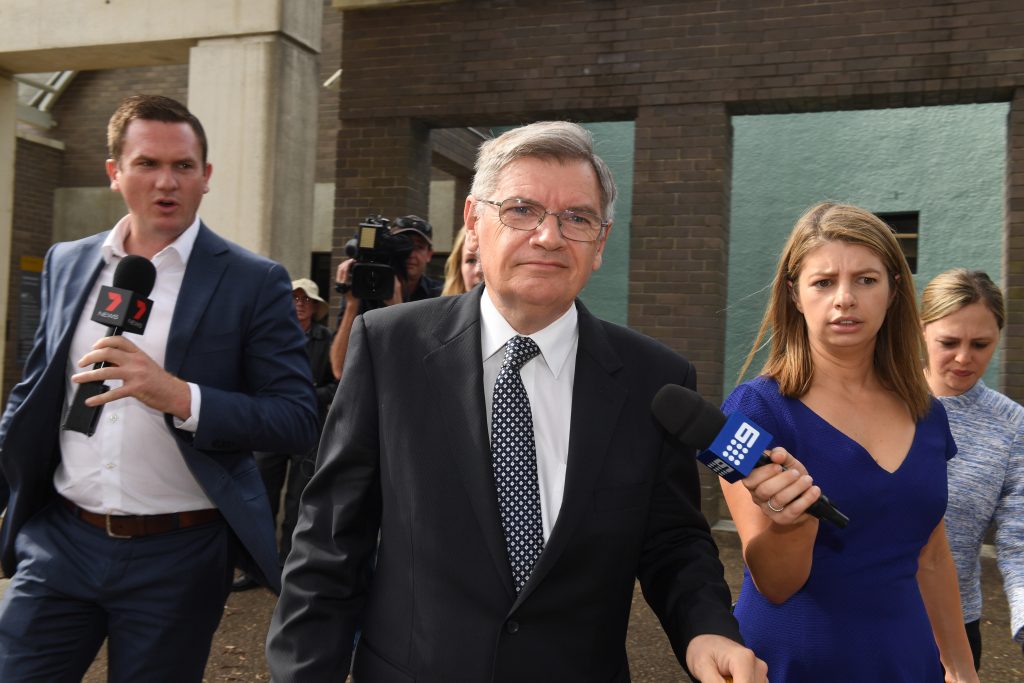
Disgraced former Sydney oncologist John Kearsley leaves Sutherland Court House after receiving community service, Sydney, Monday, October 9, 2017. Kearsley was found guilty of indecently assaulting the daughter of a cancer patient. (AAP Image/Dean Lewins)
Messages from friends and colleagues who never knew about the assault flooded in from that morning and continued for days. Hundreds of people have since reached out from around the world, both victims and witnesses of abuse, urging me to continue sharing my story. One email stood out: “Thank you for sharing your story for all of us who were never heard or believed.” I read those words over and over, tears streaming down my face. In that moment, I knew that pushing through my fear had been worth it. The purpose was now clear: this was just the beginning of my advocacy journey.
I will never forget the first time I shared my story in public. Ever since the assault, it had felt as though a shackle was choking me, silencing me whenever I tried to speak in front of people. Whether it was 5 people or 500, the same paralysis came over me. Words caught and my voice became strangled. I could speak to journalists in private, but the thought of exposing my truth to a room full of strangers seemed unthinkable.
In October 2024, I was invited to give a talk on physician wellbeing at a conference. I prepared a presentation with statistics on burnout and arguments for reform – it was all a safe distance between me and the subject. But on the plane to the conference, something shifted. The presentation felt hollow. It took all night to rewrite the entire talk. But this time it was centred on physician suicide. My own story at its core.
During the conference, waiting in the audience for my turn, I felt my body in panic. My hands were clammy, my heart hammered in my chest, and I must have run to the bathroom a dozen times. I speak at conferences regularly, but I had never shared my own story. This time, the slides were not about research or data. I was standing unprotected, offering up the part of my life I had hidden most – I would be raw, vulnerable and exposed.
When my turn came, I stood on trembling legs and walked to the stage. I thanked the chair, took a deep breath, and my voice echoed through the room. With a smile, I began with a disclaimer: “I am a recovering workaholic.”
The audience laughed.
The first slide showed my own journey with burnout – years of silent suffering, pushing myself to keep going, saying yes to everything, chasing achievement to no end. The slide told the story of how that drive left me lonely, isolated and exhausted. I spoke of how, after years of counselling, I finally began to accept that I could not be everything for everyone, all the time – and how that acceptance marked the beginning of my healing.
Then I shifted to the reality that sat heavy in the room: death by suicide is the only cause of death among physicians that is higher than in the general population. For women, the risk is 230 per cent higher and for men, 150 per cent. One in four junior doctors report suicidal thoughts. A heavy silence filled the room.
My voice cracked as I told the audience that my training had been fairly normal, my life seemingly on track until an unexpected, devastating twist. I revealed that I had been assaulted by a professor I trusted. And later, I faced the shock of reading hundreds of pages of glowing character references for him even after he pleaded guilty. It made me question my worth, and more broadly, how medicine defines success – and who, or what, is deemed worthy of protection.
I admitted that for years, I carried an exit plan. Living with shame felt unbearable and death would be the only relief. But then fate brought my son into my life. The moment the nurse handed him to me, I felt a mother’s survival instinct. I wanted to be alive for him and be the best mum I could be. From then on, I pushed myself relentlessly, working to the point of exhaustion to prove that my career was worth saving too.
I realised I had been grinding myself to the bone, trying to earn respect in medicine. Desperate for the approval of people who had chosen not to believe me, who sided with a criminal, who decided a registrar’s career wasn’t worth saving. For so long, I thought if I just achieved enough, worked hard enough, I could prove them wrong.
And then it struck me. I didn’t have to prove anything to people like that. I already was a competent, caring doctor I set out to become. The kind of a doctor I had dreamed of being when I walked into medical school full of gratitude and excitement. Their approval did not matter. I had a choice to make: to either conform to the expectation of the medical culture or to live by my own ideals.
For the first time, I felt the rush of self-compassion my psychologist spoke of for years. I had pushed away even the concept of it for years out of self-hatred. And with it came another realisation: in my relentless pursuit of achievement, I was sacrificing what mattered most. My patients. Myself. And in that pursuit, I had been utterly alone.
I saw women and men in the audience quietly wiping the tears coming down their faces. Not a single person was on their phone. Even the older men in suits – the ones who had been leaning back with arms crossed at the start – were now sitting forward, eyes fixed on me, listening intently.
“My recovery began when I reached out to people,” I continued.
I told them how ticking off to-do lists and adding new lines to my CV never brought me joy. What began to heal me was people. Coffee and lunch dates with my colleagues and time with my family. I admitted that I was still a recovering workaholic, with setbacks along the way, but I finally understood that to be the best doctor I could be, I needed to invest in what recharged me. My patients deserve to see the best version of me. I needed to allow myself the space to look after my patients with full attention, instead of scattering myself across a million tasks.
In closing, I emphasised what had taken me years to learn. No amount of achievement will make us whole and the real key to survival in medicine is kindness. We need to be kind to each other and ourselves. Kindness is what keeps us safe and able to thrive.
My final slide was a collage of faces – Sandra, Dion, Deb, Mei, Trina, Kim, Angela, Tom. The colleagues who kept me alive. I thanked them for being my voice when I couldn’t speak, for carrying me until I could walk again, and for opening doors when I didn’t believe in myself. They are the real heroes in my world. I closed with a promise: if I can help even one person the way my heroes helped me, then my life will have been worthwhile.
The room stayed silent for a beat, then the applause broke. My legs were still trembling as I stepped away from the podium, a rush of relief washing over me. Hoping I had delivered the message I had intended, I made my way down from the stage.
For the rest of the conference, people lined up to speak with me. Many simply wanted to thank me for sharing my story, but others confided far more intimate stories – colleagues they had lost to suicide, moments when they themselves thought about suicide, and personal experiences of sexual abuse at work. Listening to them, my heart swelled with a mix of sadness, gratitude, and determination. Sadness for the suffering in silence, gratitude for their trust, and determination to keep speaking up.
Over the past year, my company, in collaboration with business coach Shivani Gupta, launched a six-month online physician wellbeing program and, more recently, physician education retreats. My goal has been to empower doctors with the skills essential for a sustainable and fulfilling career – skills never taught during training. Our training as clinicians is centred almost entirely on patient care, yet we are given almost nothing when it comes to navigating workplace politics, managing difficult conversations with colleagues, or engaging effectively with hospital managers.
The reality is that many of the frustrations that wear doctors down are not about patient care at all. They come from navigating the inefficiencies of the system, managing relentless fatigue, struggling to say “no”, and working with difficult personalities – challenges that could be improved with the right education and support. I also wanted to create something medicine so sorely lacks: a safe space for doctors to speak openly about their struggles, to debrief without fear of judgement, and to share experiences that remind us we are not alone. My ultimate goal is to make medicine a less lonely place and to lift up the good people who are working to make it better.
By far, the greatest challenge after choosing to speak was not finding the words, but breaking through the shackle around my throat. Every time I stood before an audience, my throat felt strangled, the heavy weight pressing down on my vocal cords.
But healing has a way of arriving where you least expect it. For me, it came at a retreat I organised with Shivani at Sukhavati Retreat in Ubud, Bali – 7 days in a sanctuary of stillness, surrounded by women physicians who, like me, had given so much of themselves to medicine and their families. Each morning began with yoga and each afternoon with a circle. In those circles we shared intimate stories – stories of struggles and exhaustion, of loss, of resilience. There were tears, celebrations and embraces. We came as strangers, and by the end, we could not get enough of one another’s company.
In ancient times, they say people sat in circles to share their burdens and their wisdom. In that circle, I felt alive again. Alive among women who were flawed and striving, mothers and doctors, just doing their best.
On the final day, we gathered one last time. Shivani asked us to write down three things we would leave behind. On my slips of paper, I wrote: Self-doubt. Fear of judgement. The weight on my neck. Then three things I would carry home: Courage. Grounding. Optimism.
We placed our papers in a container and lit them on fire. As the flames rose, so did something in me. I saw with sudden clarity the prison I had built for myself after the assault: four walls of shame, a locked door, and a chain around my neck that dragged me back whenever I tried to leave. That morning, as the fire consumed my words, I saw the key I had always held. I unlocked the chain, stepped outside, and this time, I locked the door from the outside and threw the key back in. Tears streamed down my face as the weight lifted from my throat. For the first time in years, I was free.
On the flight back to Brisbane, the faces of those who had carried me through my darkest days appeared before me, one by one, like a film projected across the sky. For years, I had blamed myself for not healing fast enough, for being weak, for not “snapping out of it.” But as the plane hummed through the night, I finally understood: I was never meant to do it alone. None of us are. We enter this world in the arms of a mother, and we are not meant to live or die alone.
They say it takes a village to raise a child. It’s easy to forget that adults need a village too. It took a village to save me. There really was no other way.
A good life is not measured by what we achieve on our own. A good life is one lived with others, carried and carrying in turn. And when the end comes, a good death is simply to leave this world with someone you love beside you.
This is the truth I carry now. My prayer is for a world where no one is left believing that their effort alone shapes their future. Because behind every successful person, there is a village. We thrive in circles. Everybody needs a village.
What’s Been Broken Is All the More Sharp is distributed by Simon & Schuster. It can be purchased in bookshops and on their website (link here).