A minimally invasive procedure provides significant relief from knee pain and may prevent the need for knee replacement surgery in people with osteoarthritis, according to German researchers.
Genicular artery embolisation has been shown to be technically feasible and to improve scores for pain and quality of life in a one-year study involving more than 300 patients with knee OA.
The findings, presented at the 2024 annual meeting of the Radiological Society of North America, suggest there is potential for anti-inflammatory interventions that target abnormalities in the genicular arteries in the knee joint, said study author Dr Florian Nima Fleckenstein, an interventional radiologist at Charité-University Hospital Berlin.
He told the RSNA meeting in Chicago that genicular artery embolisation involves an interventional radiologist using digital angiography to identify pathological genicular artery neovessels, which are characterised by a blush-like appearance. These neovessels are then selectively catheterised using a microcatheter and guidewire to inject microparticles until the pathological vessels are occluded (link here).
While the exact mechanisms underlying the benefits of embolisation of abnormal blood vessels are still unclear, it is thought to disrupt the cycle of inflammation, reduce synovitis, cartilage destruction and sensory nerve growth that characterises osteoarthritis, said Dr Fleckenstein.
In their the study the German team conducted a retrospective analysis of outcomes for 333 patients (age 40 to 90) with moderate to severe knee osteoarthritis that didn’t respond to conservative treatments.
All patients underwent genicular artery embolisation at a single centre, with effectiveness of the procedure was measured using the Visual Analog Scale and the Knee Injury and Osteoarthritis Outcome Score. Patients’ scores for pain and quality of life, were recorded at baseline and during follow-up visits at six weeks, three months, six months and one-year post-procedure.
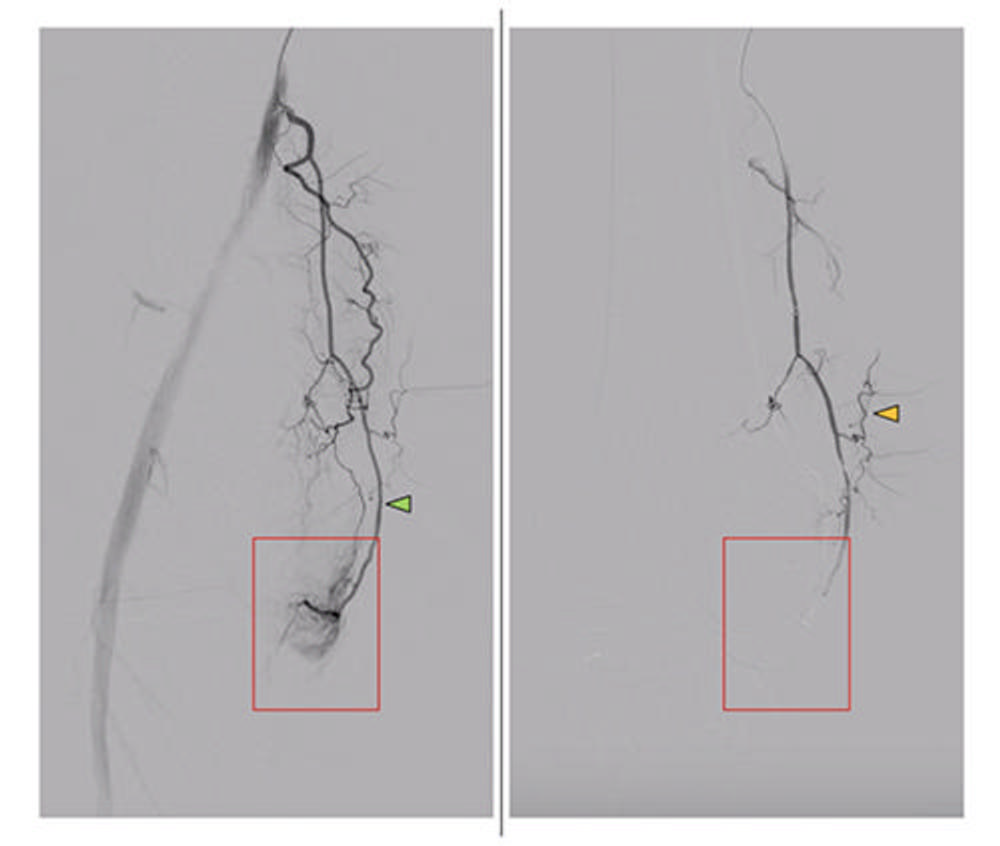
Pre and post-interventional digital angiogram of the descending genicular artery in a patient with symptomatic knee osteoarthritis of the right leg.
According to Dr Fleckenstein, technical success was achieved in 100% of procedures. Temporary slight skin discoloration and mild knee pain immediately after the procedure were noted in 18% of all cases. No severe complications were reported.
The quality-of-life index and pain scores improved by 87% and 71%, respectively, at one-year follow-up, from a median baseline of 57 (of 100) and 7 (of 10), respectively.
The study investigators concluded that genicular artery embolisation was a safe and effective treatment option across all severity grades of knee osteoarthritis, including advanced cases where other treatments have very limited efficacy.
“Our study found that [genicular artery embolisation] can effectively reduce knee pain and improve quality of life early after the treatment, with these benefits being maintained over the long term, especially for people who haven’t had success with other treatments like physical therapy or pain medications,” Dr Fleckenstein said.
“This could potentially offer a new lease on life for many patients who suffer from debilitating pain and mobility issues, caused by osteoarthritis.”
He noted that the study also showed that genicular artery embolisation was particularly effective in the early stages of knee osteoarthritis.
This suggested that early intervention could potentially delay or even prevent disease progression, reducing the need for more invasive treatments, such as surgery.
“GAE has the potential to reduce the need for more invasive surgeries, lower health care costs and significantly improve the quality of life for countless individuals suffering from knee osteoarthritis,” Dr Fleckenstein said.
“With millions of people affected by knee osteoarthritis, particularly in ageing populations, finding effective, minimally invasive treatments is critical,” he added.