What exactly is burnout? And what truly causes it? Despite growing awareness of the issue in healthcare, these crucial questions remain surprisingly elusive. The next step of moving beyond burnout to foster fulfilment among health professionals feels further still.
The statistics will be familiar to many. Even back in 2013, 32% of Australian doctors reported emotional exhaustion in a now-infamous beyondblue survey (link here). Some 35% said they were struggling with cynicism in their professional lives, a problem that has likely only grown in scale in the years since.
“Herein lies the paradox: the very moral and emotional engagement that is required to perform our jobs will also drain us, if there aren’t adequate resources,” says nursing academic Professor Mark Lazenby, of University of California, Irvine.
“Fulfilment does not hinge on the absence of challenges. Rather it emerges in intentionally navigating them.”
Professor Lazenby was speaking to Australian healthcare workers at a webinar held by The Plunkett Centre for Medical Ethics earlier this month, to explore how healthcare professionals might reclaim a sense of purpose amid institutional constraints.
“I am faithful, I do not give out,” Professor Lazenby quoted from Whitman’s ‘The Wound Dresser’, “the fractured thigh, the knee, the wound in the abdomen, these and more I dress with impassive hand, yet deep in my breath rests a fire burning, a flame.”
This tension between clinical detachment and compassionate engagement lies at the heart of what Professor Lazenby termed “rational compassion” – a concept he positioned as crucial for sustainable practice.
“Empathy is the tendency to absorb another’s feeling as one’s own,” he explained. “Compassion, on the other hand, recognises someone else’s emotions without taking them on, but is always coupled with a strong desire to alleviate suffering.”
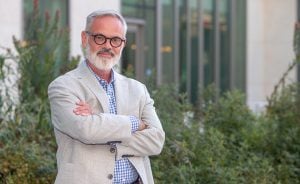
Professor Mark Lazenby
For Australian physicians grappling with increasing demands and diminishing resources, this distinction may prove vital. He said his approach offered a middle path between emotional withdrawal and the compassion fatigue that can result from taking on patients’ suffering as one’s own.
The interplay between science and humanity emerged as another key theme of the discussion. Professor Lazenby characterised healthcare as simultaneously scientific and spiritual, with fulfillment arising from the synergy between these dimensions.
“A clinician who excels at interventions but neglects the human dimension risks alienation and detachment,” he cautioned. “Conversely, focusing solely on emotional labour can lead to ineffective or harmful care.”
He was speaking alongside St Vincent’s Hospital, Sydney, nursing director Nicole de Tullio who reflected on how this balance manifests in daily practice.
“If my team’s happy, I’m happy and I’m fulfilled,” she said. “It’s that connection, that camaraderie, that collaboration with teams where they feel empowered to innovate and care for patients in a way that is deeply personal but also rational.”
The conversation then turned to practical strategies for cultivating fulfillment. Professor Lazenby suggested incorporating gratitude practices into clinical routines, particularly during handover.
“Let’s name one thing that we found fulfilling, one act, one moment that we felt good about in the shift,” he proposed, citing psychological research on the benefits of gratitude practices.
He also encouraged healthcare professionals to cultivate awareness of “awe” in everyday practice—recognising the profound nature of seemingly routine clinical interactions.
“These small acts of attunement—a colleague’s reassuring touch or a genuine moment of laughter together in the breakroom—can serve as anchors of fulfillment,” he noted.
The discussion wasn’t without acknowledgment of healthcare’s significant challenges. When asked how to maintain fulfillment in areas with low success rates, such as addiction treatment, Professor Lazenby acknowledged the difficulty.
“I think it comes down to your sense of commitment to the greater good, and recognising your own limits,” he responded, adding that not everyone had the capacity to work in such challenging areas indefinitely.
Beyond that, he offered a timely reminder that institutional constraints—while real and significant—need not define health workers’ professional experiences.
“Meaning does not vanish, rather it emerges when confronted with constraints,” Professor Lazenby told attendees, suggesting that the very limitations of modern healthcare could become opportunities for meaningful moral action.
Ms De Tullio stressed that despite challenges faced during the pandemic, Australian healthcare demonstrated remarkable resilience.
“Despite the shortfalls and stresses on nursing, we’re really experiencing great recruitment and retention in the workplace at the moment, which is probably surprising,” she said. “It just shows the resilience and the agility and the flexibility of nurses just getting on with it.”
Professor Lazenby added: “Fulfillment lies not in escaping hardship, but in choosing rationally to meet it with moral courage and an open heart.
The full webinar is available on YouTube (link here).