
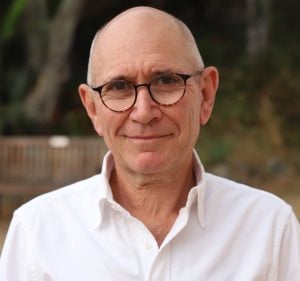
Professor Michael Friedlander
Patients with recurrent ovarian cancer who remain progression-free for at least five years on maintenance PARP inhibitors have excellent long-term outcomes regardless of whether they continued treatment, according to an Australian-led international study.
The findings challenge the long-standing practice of continuing PARP inhibitors until disease progression or unacceptable toxicity in exceptional responders and raise the possibility that a subset of patients may ultimately be functionally cured.
Researchers found patients who discontinued therapy for reasons other than disease progression did not appear to have poorer long-term outcomes than those who remained on treatment, offering some of the first evidence to guide decisions about how long maintenance PARP inhibitors should continue.
The retrospective study, published in JAMA Oncology [link here], included 320 patients from 41 centres across 14 countries with platinum-sensitive recurrent ovarian cancer who remained progression-free for at least five years after starting maintenance PARP inhibitors.
Researchers followed patients for a median of 6.8 years.
Key findings
- Progression-free survival was 88.8% at 7.5 years and 78.7% at 10 years, while overall survival exceeded 90%.
- Stopping treatment did not appear to compromise outcomes. Ten-year progression-free survival was 90.1% among patients who discontinued PARP inhibitors for reasons other than disease progression compared with 72.5% among those who continued therapy.
- Of the 320 patients, 110 discontinued maintenance PARP inhibitors during follow-up, including 85 for reasons other than disease progression such as physician recommendation, patient choice and adverse effects.
- Serious late toxicity was uncommon. Forty-three per cent of patients required dose reductions because of adverse events, fewer than 7% discontinued treatment because of toxicity, and five patients (1.6%) developed myelodysplastic syndrome or acute myeloid leukaemia.
- Investigators said the observational study could not determine whether treatment discontinuation itself improved outcomes or establish the optimal duration of maintenance therapy.
Lead investigator Professor Michael Friedlander, medical oncologist at Prince of Wales Hospital in Sydney, said the study was prompted by a dilemma that emerged as more patients experienced unexpectedly durable responses to maintenance PARP inhibitors.
“When the clinical trials of maintenance therapy in the recurrent setting were designed, no-one expected that there would be a group of patients who were exceptional responders and hence the protocols all mandated continuation of PARP inhibitor until progression or unacceptable toxicity,” he told the limbic.
“However, over time, it became clear that a subset of patients were not relapsing and continuing on treatment for years.
“We wanted to know, ‘How long is long enough?'”
The absence of evidence had already led to markedly different approaches in clinics around the world.
Before undertaking the study, Professor Friedlander said he asked colleagues how they were managing patients who had remained progression-free for many years.
“I asked colleagues from all over the world what their policy was with regards to duration of treatment in exceptional responders and there was very wide variability. Some centres ceased treatment at 5 years, others at 10 years while others continued indefinitely.”
Clinicians’ own experiences also shaped those decisions.
“Personal experience does impact on attitudes re duration of treatment.”
Professor Friedlander recalled one patient who was an exceptional responder who remained free of recurrent ovarian cancer after 10 years of maintenance PARP inhibitor therapy before developing myelodysplastic syndrome.
“She sadly died. She had no evidence of recurrent ovarian cancer and I was very concerned that this could be the fate for other exceptional responders which underscored the importance of the study.”
He said the findings also provides reassurance about one of the biggest concerns associated with prolonged maintenance therapy.
While 43% of patients required dose reductions because of adverse events, fewer than 7% discontinued treatment because of toxicity. Just five patients (1.6%) developed myelodysplastic syndrome or acute myeloid leukaemia despite prolonged PARP inhibitor exposure.
Professor Friedlander said the low incidence was particularly reassuring.
“Most cases of MDS/AML occur quite early within a year or 2 of commencing maintenance PARP inhibitor following response to platinum based chemotherapy for recurrent disease and we were only looking at exceptional responders alive without evidence of recurrence for > 5 years which is a select and different population.”
“Furthermore, I think the risk of MDS/AML is increased in patients with recurrent ovarian cancer who have been on a PARP inhibitor and then receive further platinum based chemotherapy after progression,” he suggested.
For Professor Friedlander, the findings help answer a question that had previously relied largely on clinical judgement.
“Prior to this study, we did not have reliable data on a sizeable number of patients to support such discussions,” he said.
“My personal view is that cessation of maintenance treatment is a reasonable option in exceptional responders.”
The study does not establish an optimal treatment duration, but Professor Friedlander said he would generally begin considering treatment cessation after seven years or more in carefully selected patients.
Before recommending treatment cessation, he would want to see a normal PET-CT scan together with a normal, stable CA125 over several years.
Circulating tumour DNA may eventually provide another layer of reassurance.
“Even though most exceptional responders tolerate treatment well, there are side effects associated with treatment such as fatigue and although we don’t have good data, I think quality of life is likely better off treatment.”
The study also offered clues as to why some patients experience unusually durable responses.
Exceptional responders were enriched for particular BRCA1 and BRCA2 variants, while the only baseline clinical characteristic independently associated with longer progression-free survival was an interval of at least 18 months between initial diagnosis and first recurrence.
Whether those patients can be identified earlier remains one of the field’s biggest unanswered questions.
“This is a very important question – we simply don’t know the answer,” Professor Friedlander said.
“The results of this study have been the catalyst for another study where we are attempting to answer this question so watch this space.”
Professor Friedlander said understanding the biology of these tumours represented one of the study’s most important legacies.
“It is not possible to carry out clinical trials to determine the optimal duration of PARPi maintenance in exceptional responders but large multinational retrospective studies, although difficult to carry out are worthwhile and can inform clinical practice.”
The researchers said their findings also raise the possibility that some exceptional responders may ultimately achieve what has been termed a “functional cure”, while emphasising that longer follow-up is needed before that concept can be adopted confidently in clinical practice.
Professor Friedlander urged caution.
“Cure has not been considered a realistic possibility in patients with recurrent ovarian cancer.”
“The term ‘functional cure’ has been used to describe a state in which the disease has been effectively controlled without ongoing therapy and the patient has a normal or near normal life expectancy and quality of life but cannot use the term cure with confidence as possibility remains that there may still be very low volume undetectable disease.”
Investigators plan to revisit participating centres in the coming years to update follow-up from the cohort.