
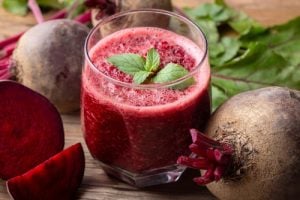
 While the world’s attention is on the food fads of footballers and whether raw milk explains the power of Norwegian striker Erling Haaland, researchers have found dietary nitrate (NO₃−) supplementation via beetroot juice increases exercise capacity in people with IPF.
A study, published in Thorax [link here], supports other evidence from the same researchers for oral nitrate in people with COPD and pulmonary hypertension (PH) and in other studies of healthy adults.
“On the basis of this positive single-dose trial, longer-term studies to establish the clinical effects of dietary nitrate supplementation would be a reasonable next step,” it said.
The EDEN-OX3 study, led by investigators from the UK, involved 20 stable adult outpatients with IPF who desaturated on exercise, were not hypotensive and did not have renal impairment.
Following baseline measures of exercise capacity, brachial artery flow-mediated dilation (FMD), and relevant blood biomarkers, participants received a single 140 ml dose of either nitrate-rich or nitrate-depleted beetroot juice (placebo) at subsequent visits and had repeat tests 3 hours later.
Participants in each arm crossed over to the other intervention during a follow-up visit between 1 – 4 weeks later.
The study found nitrate-rich beetroot juice improved endurance shuttle walk test (ESWT) performance with a median difference of 31 seconds (p=0.0438) compared to placebo.
“Seven of 20 participants had a difference in ESWT favouring the active intervention that exceeded the 65 s minimal clinically important difference (MCID), compared with two for placebo,” it said.
The study also found endothelial function improved with nitrate supplementation given a statistically significant increase in the change in %FMD between dosing with the nitrate-rich versus nitrate-depleted beetroot juice (median difference 4.25%; p=0.036).
Blood pressure, heart rate and oxygen saturation responses 180 min after dosing did not differ between treatment arms.
Regarding blood biomarkers, the study found a statistically significant increase in plasma NOx with nitrate-rich versus nitrate-depleted juice (p<0.0001), but no statistically significant differences for 6-ketoprostaglandin, asymmetric dimethylarginine (ADMA), L-arginine, endothelin-1, or the Arg/ADMA ratio.
In exploratory analyses, responders were younger than non-responders (66 v 76 years; p=0.014). No significant differences were observed in Medical Research Council dyspnoea score, TLco % predicted or prewalk Borg score.
“The EDEN-OX3 study presented here demonstrates that, in people with IPF who desaturate on exercise, acute dietary NO₃− supplementation in the form of beetroot juice increases exercise capacity and improves endothelial function,” the investigators said.
“This adds to data in people with COPD and PH and opens up the possibility of dietary NO₃− supplementation as a therapeutic approach for people with IPF.”
While the findings suggest a vascular improvement primarily consistent with their previous findings, they said the underlying mechanism remains uncertain.
“Reduced nitric oxide (NO) bioavailability may represent a modifiable therapeutic target through dietary nitrate supplementation, where NO₃− is reduced via nitrite (NO2−) to NO,” they said.
“NO has vascular effects on endothelial function, platelet aggregation and angiogenesis, while in skeletal muscle, it modulates blood flow, contractility, mitochondrial respiration and metabolic homeostasis, thus enhancing energy efficiency and exercise performance.”