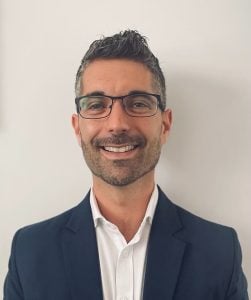
Dr Dov Degen
Dual trained nephrologist and general medicine physician Dr Dov Degen has many irons in the fire, reflecting his passion for keeping things interesting and making a difference, but it’s his commitment to destigmatising mental health issues that has earned him a King’s Birthday honour.
Dr Degen, from Eastern Health and in private practice in East Malvern, Melbourne, has been recognised with a Medal of the Order of Australia (OAM) for his service to medicine, and to mental health support.
He told the limbic that the first indication of the honour was an unexpected call from Canberra asking for his contact details which he thought sounded very suspicious.
However, since receiving confirmation that it was indeed the heads up on an OAM, and not a prank call or scam, it’s been hard to keep the welcome news a secret.
“I became a mental health advocate in 2015 for SANE Australia, and then later for Beyond Blue, and I’ve essentially been campaigning to destigmatise the way mental illness is perceived amongst doctors and within healthcare,” he said.
“My primary motivation is that I’ve got a diagnosis of bipolar disorder, which I’m very open about. I have a unique angle, and I’ve lived both sides of the fence as a medical practitioner helping patients with psychosocial issues, but also as a patient myself.”
Dr Degen said he has felt the sting of stigmatisation by both the medical community and wider society and wants to turn that around.
“There’s not many of us that openly disclose our illnesses for fear of stigmatisation and risks to job progression. I want to change the culture of how mental illness is perceived. I want mental health challenges to be treated on par with physical illnesses, so for example, a colleague will have no trouble calling in sick because of a migraine, but they’re not going to call up and say ‘I have anxiety today’ or ‘I have depression today’.”
“I’d like to see open disclosure. I would like to see equality whereby mental health is treated the same as physical health. I’d like to see policy change, and unfortunately the medical world responds to nominals… I will have no qualms in using this award to boost this message at a national level and try to influence the senior policy makers who today are still not listening.”
Advocacy
He’s already spoken at hospital grand rounds, community events, in social media campaigns, podcasts, and radio programs – “…essentially any opportunity to discuss mental illness and its impacts on society, but with a particular passion for how it affects doctors.”
Dr Degen said doctors’ mental health was still swept under the carpet and not fully addressed.
“If you have the death of a patient in a hospital that goes to a committee that goes to a root cause analysis. We look at all the reasons why the patient died. We practice open disclosure by apologising to the family, all those sorts of responses. Whereas when one of our colleagues dies by suicide, nothing. We get an email,” he said.
“The wider community needs to know that mental illness doesn’t discriminate, and doctors and medical students and nurses have a higher prevalence of mental illness-related issues than mainstream society, and yet we’re not game at tackling it ourselves so I want to open up this conversation because I think it’s been silenced for far too long.”
Dr Degen said patients with mental illness also need better care. For example, he sees patients with bipolar disorder referred to him with kidney diseases from their lithium, including lithium nephrotoxicity and polyuria.
“I’ve got a unique angle in managing it, because I understand the balance between protecting their mental health – because lithium is the gold standard for bipolar – but also looking at the other factors. Psychiatrists don’t manage the medical comorbidities.”
He said some nephrologists might suggest stopping the lithium but that then carried a high risk of relapse, morbidity, and inability to work and contribute to society.
“It needs to be a much more nuanced conversation. While it is a very good drug, we also have to be aware of potential side effects, and we need clinicians who are able to manage it as well. So that’s a separate passion of mine – being the physician in between that looks at the balance of these issues.”
Varied practice
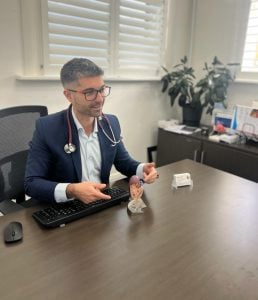
Dr Degen said he enjoys a broad scope of practice which is mainly nephrology and includes extending care through to the end of life via voluntary-assisted dying (VAD).
“I’m very passionate about euthanasia and people’s right to die and I was involved in the first landmark dialysis withdrawal case, where the patient wanted to do euthanasia following withdrawal from dialysis. There was a lot of bureaucracy with the board, but we got the case through.”
In Victoria, the VAD legislation requires assessment by at least one physician in the specialty relevant to the patient’s terminal illness.
“I do the euthanasia work because there’re not many doctors who are trained to do it. If someone has a terminal kidney condition, then they have to see me or another nephrologist. If we’re not available then they can’t have it.”
He also does locum work in Coober Pedy “…because there’s a gap in Indigenous medicine and I recognise that they need care that is not being delivered.”
Dr Degen said he also works in perioperative medicine for a group of orthopaedic surgeons, was director of physician education at Eastern Health for four years, and is now a professional practice tutor for Melbourne University and a teaching associate for Monash University.
“I think that we’re always learning and evolving and I know what my skill sets are and my unique interpersonal ethic. I’ve selected things within my career that give me joy, so for example, education doesn’t pay very much but it gives me a lot of joy and satisfaction.”
“I do a lot of mentoring for junior doctors, and part of that is the mental health advocacy, so I use the principles of that with the education to train the next generation of doctors to hopefully feel more comfortable and safe to speak up about their vulnerabilities, clinical mistakes, and difficulties as well.”
Dr Degen has also stepped up in a committee role contributing to Victoria Health’s mental health and safety framework.
“It’s a framework that makes sense. It talks about empowering people in the workplace to speak up, it talks about reporting channels – all the things that are just common sense. But I’ve looked at that framework and I’ve actually presented it to my hospital, and we don’t have any of that,” he said.
“It’s one thing to know idealistically what to do when in practice what we see are things like R U OK Day. Giving doctors cupcakes once a year is not going to solve this multifactorial systemic problem. We need to give it the resources and attention it deserves to change it, so I think it’s very frustrating for most of us to have these tokenistic days but no actual affirmative action.”