Public health leaders are demanding answers after Philip Morris International was allowed to give secret evidence to a Senate inquiry into Australia’s illicit tobacco crisis.
The tobacco giant appeared in a closed hearing before the Legal and Constitutional Affairs References Committee, which is examining the surge in illegal tobacco. Critics say the arrangement breaches Australia’s obligations under the World Health Organisation’s Framework Convention on Tobacco Control, which requires signatories to shield health policy from tobacco industry influence.
Calls for transparency
Lung Foundation Australia (LFA) CEO Mark Brooke said the secrecy undermined public trust.
“Illicit tobacco is a serious and growing public health threat,” he said. “To allow a tobacco company to give evidence behind closed doors on an issue of this scale is deeply concerning. Transparency must be non-negotiable.”
The committee is chaired by Liberal Senator for South Australia Leah Blyth, who defended the decision.
“We must be mindful not to silence those with whom we do not agree, especially businesses who are directly involved in the sector,” she said. “It doesn’t make sense to have an inquiry into illicit tobacco and not hear from all entities impacted.”
Assistant Minister for Citizenship, Customs and Multicultural Affairs Julian Hill called on the Liberals to apologise and release the full transcript immediately.
“There are two other Big Tobacco companies who have made submissions to the inquiry,” he said. “Will those companies be given secret hearings as well?”
Mr Hill also questioned why tobacco companies had failed to respond to requests from Australia’s Illicit Tobacco Commissioner regarding their supply chains.
Don’t cut the excise
The LFA, Australian Council on Smoking and Health (ACOSH) and Cancer Council Australia (CCA) jointly called on the inquiry to reject tobacco industry arguments that cutting tobacco excise would curb the illegal trade.
ACOSH CEO Laura Hunter said the logic was flawed.
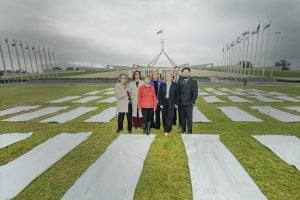
Body bags at Parliament House
“You don’t tackle a public health crisis by engaging in a race to the bottom with criminals,” she said. “When cigarettes are cheaper, more people take them up, people already addicted smoke more, and fewer people quit.”
Ms Hunter said the real solutions were stronger enforcement, tougher penalties, and a coordinated national response. She also pointed to the oversupply of retail outlets as a major driver of both smoking rates and the illicit market.
“There are over 40,000 outlets selling tobacco in Australia, far more than essential services like supermarkets, petrol stations, and pharmacies,” she said.
The three organisations laid 66 body bags on the lawns of Parliament House, representing the number of Australians estimated to die each day from tobacco-related diseases including lung cancer.
The TSANZ has also warned that calls to weaken tobacco control measures in response to the illegal tobacco trade would cause serious and lasting harm to public health.
“TSANZ is concerned by the privileged access being granted to the tobacco industry and the secretive way this hearing has been conducted,” its CEO Vincent So said.
“If the tobacco industry is invited to provide evidence to the inquiry, it should be out in the open where it can be challenged, as appropriate, by public health and medical experts.”
Australia is a signatory to the World Health Organisation’s agreement on tobacco control – which is meant to protect health policy from the tobacco lobby – but the Coalition is happy to give Philip Morris secret hearings at Senate inquiries, and the Nationals still take donations…
— Dr Monique Ryan MP (@Mon4Kooyong) May 5, 2026