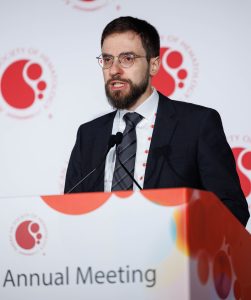
Dr Othman Al-Sawaf
Fixed-duration treatment with venetoclax–obinutuzumab or venetoclax–ibrutinib has been found to be noninferior to continuous ibrutinib with respect to survival in patients with previously untreated CLL.
The international CLL17 study, presented in the Plenary Scientific Session at ASH 25 and concurrently published in the NEJM [link here], found in a prespecified interim analysis that progression free survival (PFS) and overall survival (OS) were similar in the three groups.
The investigators, led by Dr Othman Al-Sawaf from the University Hospital of Cologne, Germany, said the trial provides an important direct comparison between fixed-duration and continuous targeted therapy.
The combination treatments provide the deeper remission which enable patients to stay off treatment for periods of time.
“Given the clinical advantages of treatment-free intervals, fixed-duration therapy may be considered in most patients with untreated CLL. Ongoing follow-up will clarify outcomes in subgroups, remission durability, and overall survival.”
The study comprised 909 adults with previously untreated CLL recruited from 174 sites in 13 countries, and randomised to either fixed-duration venetoclax–obinutuzumab, fixed-duration venetoclax–ibrutinib, or continuous ibrutinib. Fixed duration treatment was for about 12 months.
After a median follow-up of 34.2 months, the 3-year primary end point of PFS was 81.1% in the venetoclax–obinutuzumab group, 79.4% in the venetoclax–ibrutinib group, and 81.0% in the ibrutinib group.
The overall response was 84.2%, 88.5%, and 86.0%, respectively.
At 3 years, overall survival was 91.5% with venetoclax–obinutuzumab, 96.0% with venetoclax–ibrutinib, and 95.7% with ibrutinib.
The investigators said that genetic risk factors such as del(17p) or TP53 mutation and unmutated IGHV remain important.
“After 3 years, patients with unmutated IGHV did not have poorer outcomes with fixed-duration therapy than with continuous ibrutinib, supporting time-limited strategies,” they said.
“For patients with del(17p) or TP53 mutation (or both), outcomes were favorable with BTK inhibitor–containing regimens, although the small subgroup size (<8%) and limited follow-up preclude firm conclusions.”
Regarding safety, the most common adverse events were infections including COVID-19, gastrointestinal disorders, and cytopenias.
The investigators said infections remain a challenge with serious adverse events occurring in 64.1% of the patients in the venetoclax–obinutuzumab group, 46.9% in the venetoclax–ibrutinib group, and 47.7% in the ibrutinib group.
The study found the incidence of infections of grade ≥3 in the three groups was 15.8, 11.2, and 12.4 cases per 1000 patient-months.
Fatal infections accounted for most deaths – 12 in the venetoclax–obinutuzumab group, seven in the venetoclax–ibrutinib group, and three in the ibrutinib group.
In adverse events of interest, tumor lysis syndrome occurred in 12 patients in the venetoclax–obinutuzumab group, four with venetoclax–ibrutinib and one with ibrutinib.
“Only 3 of the 17 cases of tumor lysis syndrome were linked to venetoclax; most occurred after the first obinutuzumab infusion.”
Cardiac disorders were reported in 13.9% of the patients in the venetoclax–obinutuzumab group, 23.8% in the venetoclax–ibrutinib group, and 34.6% in the ibrutinib group.
“Unfit patients in our trial appeared to benefit most from fixed-duration therapy. Although next-generation BTK inhibitors may have a better cardiac side-effect profile than fixed-duration therapy, the favourable efficacy and safety of both venetoclax–ibrutinib and ibrutinib suggest that results from our trial can be generalised to situations in which the choice of treatment is between fixed-duration and continuous therapy in patients with CLL,” they said.
“Whether next-generation BTK inhibitors have better cardiac side-effect profiles than ibrutinib is being addressed by ongoing trials such as MAJIC and CELESTIAL-TNCLL.”
They noted that that the study was ongoing and continued observation was essential to determine whether PFS curves could diverge over time, especially among subgroups with high-risk biologic characteristics.
The study was supported by AbbVie, Janssen Pharmaceuticals, and Roche Pharmaceuticals.