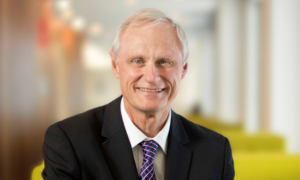
Professor Nick Talley
A leading physician says mass psychosis might be the only explanation for why we continue to allow fossil fuel companies to run amok extracting as much profit as possible from coal, oil and gas, despite irrefutable evidence of the damage being done to the environment.
Speaking at the Doctors for the Environment Australia (DEA) Health + Climate Forum in Parliament House, Canberra last week, Professor Nick Talley said it was madness to ignore the risks climate change posed to the health and future survival of all species on a magnificent planet.
“To destroy it for short term monetary gain…is frankly, psychotic. It’s mass psychosis, actually,” said the gastroenterologist, former president of the RACP and editor of the MJA.
He said we were already seeing health effects locally such as changing patterns of infectious diseases including melioidosis and Japanese encephalitis.
“These are things we’re already starting to see because of global warming, and we’re going to see a lot more of it. We’re all going to have to become experts in managing heat stress, heat stroke, and heat injury down the track. There seems little doubt about this. And the problem is, of course, this doesn’t just affect people who are unwell or elderly. The exertional heat stroke issues are going to affect our young people and people working outdoors as the temperatures continue to rise.”
Professor Talley, Board Chair of DEA, said the health impacts of air pollution, including that from bushfire smoke, were also both short and long term.
“Sydney, Melbourne and Canberra were covered in bushfire smoke in 2019 and many people were exposed. Some had acute asthma and other attacks, and there were more hospital emergency visits that spiked because of this, it’s believed. But the point is, there are long term health effects that people won’t yet have manifested.”
“And then the question is, what can you do?”
He called for his medical colleagues to do everything they can with their sphere of influence.
“I think as health professionals, we can do an awful lot, and we’ve done this before. We did this with smoking. In the 60s, the tobacco industry was supporting doctors who would say that smoking is good for you, or smoking is not bad for you, or don’t worry about smoking. But doctors made a big difference in driving changes in legislation that led to the smoking decreases that we’ve seen.”
“So doctors can make a real difference by the work that they do, by the advocacy that they do, by the influence that they have, by the trusted voices that they are.”
Duty of care
Professor Talley said health professionals also had a duty of care to do something about climate change.
“We have a duty of care to educate our patients, our colleagues and our communities, to grow research, build resilience, and decarbonise where we can in the health system. And, of course, to use our voices loudly and look for change.”
He said the health system accounts for 7% of global emissions overall. Yet it was possible to change that, as demonstrated by work in the UK.
“The NHS has been a world leader in decarbonising … led by Nick Watts initially, an Australian who was the Chief Sustainability Officer for the NHS. They reduced their carbon emissions, they saved money, and they found their staff absolutely loved everything they did.”
“Here in Australia, there is work going on at the state level which is making a difference, but it is incredibly patchy around the country. Every hospital should really have a plan to go to carbon net zero at some point.”
“We have a plan at the John Hunter Hospital in working towards carbon net zero,” he said.
One of the initiatives was hospital rooftop solar panel installation – some 5,300 solar panels over 12,000 square metres of roof space – believed to be the largest in a hospital anywhere in the country.
“And we’ve got plenty of space for this, and obviously it’s a very sensible thing to do in terms of your own power generation.”
He said doctors can also work together in groups such as DEA to advocate for change.
However not every initiative would be successful – such as DEA’s failed Federal Court challenge of the National Offshore Petroleum Safety and Environmental Management Authority (NOPSEMA) decision to approve the Scarborough gas project in WA.
“We went in because somebody has to stand up to these issues, and that includes us as health professionals. And if we don’t do it, can we expect anyone else to have a try? Yes, we’ve done this at great cost to us. It’s David versus Goliath, and we haven’t given up yet,” he said.
Time to act
Professor Talley said the recent landmark decision of the UN’s International Court of Justice that countries have a legally binding duty to prevent significant harm to the climate would probably drive many more legal challenges.
“I would argue our fossil fuel subsidies will be seen as something that is a horrific approach that needs to be challenged and will be in the future.”
“There’s much we can do here, there’s much we can advocate for, there’s change that can happen…but it is urgent. That’s really the problem.”
Importantly, the government will soon be setting new 2035 emission reduction targets.
“What’s it going to be? I’m very much hoping it’ll be ambitious… some have argued that 75%, 80%, even 85% is achievable. We need to take aggressive action because we cannot wait till 2050 or 2045 to take real action. It’ll be too late, possibly… we’ve just got to make a difference as quickly as we can.”
Professor Talley told the limbic that doctors were incredibly busy with their lives and their practices but the impact of climate change on health was now fundamental to their core business.
“The work doctors do is very important. It’s stressful, it’s high pressure, and so you can understand doing something else is really hard.”
“I look at it this way, we swore an oath to look after our communities. The health impacts of climate change, the health impacts of fossil fuels on our communities, our own families, and ourselves are such that we have an obligation to do something.”
“It’s a little bit like teaching medicine. We’re really busy, but many of us in the profession will go and teach because that’s part of our obligation. We swore an oath to disseminate the knowledge we have as well as provide great care as best we can. So I see it that way. I see it as a commitment that we are required to do,” he said.
“I think it’s fair to say everybody needs to accept they have a role to play, small or large… but to do nothing? It’s like walking past a patient deciding you’re not going to take care of them, even though they’ve collapsed, they’re right there…and you’re the only person who can do something. Well, are you going to walk past? Are you going to do something? Most of us would do something.”